

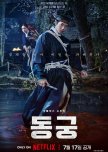
The story is at its core rather simple, but it layers things quite effectively, so it has enough questions that need answers and things aren’t quite as it seems. There is enough escalation within the narrative, as the haunting mirrors the power grabs and struggles of those seeking control of the power within the palace, for the tension to slowly ramp up all the way to the end and keep the story engaging.
But it also keeps the storytelling tight enough while poring the focus on the characters, their journeys, and the complex relationships and guilt that comes with it that shape the story. In the end it Iall becomes symbolism for how cruelty and greed will eat you up and ultimately come back to haunt you.
The drama does a lot of storytelling just by evoking eerie atmosphere within the narrative and using stark color palettes and saturation, visually striking shots, and music to evoke mood and theme, as well as with just a look, or a scowl from the phenomenal cast of actors it had at its disposal. It manages to deliver a lot without words, and even the world building never feels too heavy or exposure. It is almost as if the drama relies on the viewer already knowing a bit of the myths surrounding ghosts.
The palace intrigue is kept relatively simple and a lot of it does feel eerie familiar, especially at the beginning, but as we got further into it one could appreciate how much the simplicity of the palace plot allowed the characters to breathe and come into their own. Despite the small number of episodes and running time compared to the standard kdrama, it did a lot of good character work within that tight frame. Truly no minute felt wasted.
And it manages to convey longing, love, and even romance in such a subtle way, as the leads sacrifice themselves to save the other repeatedly because they don’t have anyone else. And yet it always felt earned and never just because the story needed them to.
The action, visuals, creature design, and horror elements are all well executed, stunningly cinematic, and in general thrilling to watch. But I am not sure if it would have worked as well if the drama hadn’t done it’s due diligent to make the viewers care about and understand our two leads.
These two lost souls who have never once received respect or the love of their parents meeting a stranger who shows them the warmth they have been seeking, to the point that they want to fight the king, monsters, and even hell to hold onto that warmth just a little longer. That is the emotional tether of the drama and its heart, and the story utilizes that exceptionally.
It is rather obtuse about the ghosts and almost expects viewers to know, figure things out as they go along, or simply allow it all to remain shrouded in mist. That works here, because it helps the whole thing feel eerie, murky, and deeply atmospheric. And I for one enjoy media that trusts me as a viewer and doesn’t spoon-feed me info dumps. It also allows the atmosphere, character work, and relationships within the story to shine: the king and his daughter, the old women in the palace plotting behind the scenes, and the two leads all feels so raw and real. That brings out the emotional side of the story, which is where kdramas usually shine.
The East Palace keeps things simple but uses that to its advantage. You don’t need a crazy, new plot or endless twists and turns that shock the viewers. You need some heart and good characters to tell a story. And this story knew what to focus on, what to leave in shadow, and how to make its limited time frame count and what to make the narrative focus on so it never becomes just visually striking but hollow action-piece. For the horror and action to have actual stakes, the viewer must care about the characters, and that is where The East Palace succeeds most. Beneath the ghosts, some monsters of varying cuteness, palace politics, and blood spilling action, it is ultimately a story about two lonely people finding warmth in a world built on cruelty, and that emotional core is what lingers with the viewer long after the drama is finished.
Cet avis était-il utile?
The Best Chinese Drama of 2026 ⭐?
This is my first time reviewing a C-drama, and all I can say is… it’s perfect!The story, the acting, the writing, the soundtrack everything is just so good. I never wanted it to end. This drama gave me something to look forward to every day, and it made me so happy.
The female lead is one of the best characters I’ve ever seen. She’s smart, knows her worth, and proves that she doesn’t need a man or a relationship to be complete. She’s become my role model.
The male lead is amazing too. He can beat anyone, but when it comes to the female lead, he’s just a loser in love and it’s the cutest thing ever.
Thank you for creating such an incredible drama. ❤️
Cet avis était-il utile?
THE HAUNTED PALACE PART 2
This is what happens when production and cinematography get prioritized over storytelling. The plot was underwhelming and lacked impact. Sure, the visuals were stunning, but beyond that the story fell flat, basically a summarized version of Haunted Palace.Honestly, the story isn’t gripping or exciting at all. It feels like a copy of Haunted Palace at least that one prioritized storytelling over flashy cinematography. I don’t get why some Kdrama fans drool over this just because of the pretty visuals. Sure, the CGI is solid and the actors are great, but overall it’s underwhelming. I kept zoning in and out, dragging myself just to finish it.
Cet avis était-il utile?
Cette critique peut contenir des spoilers
Yes, you were my first love, and first love never, ever dies
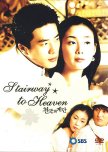
Among the many dramas that have left their mark on Korean television, some continue to move viewers with a power that transcends any purely narrative explanation. Not because they defy the conventions of their genre, but because they still touch the heart even when every plot twist is familiar. Stairway to Heaven undoubtedly belongs to this rare category.More than twenty years after its original broadcast, it remains one of Korean television's most iconic melodramas and, arguably, one of its most disarming. Its plot alone contains many elements now dismissed as clichés: an all-consuming love that defies time, a family turned into a place of rivalry and oppression, a shattered identity, a fate that relentlessly thwarts every chance of happiness, and a final sacrifice that carries the melodrama to the edge of legend.
To regard Stairway to Heaven merely as one of the seminal works of the so-called ‘Dramaverse’, however, would be reductive. Rather than inventing a formula, the series belongs to a much older tradition, rooted in the 19th-century novel, the feuilleton, cinematic melodrama and the fairy tale. It moves across these traditions without losing their emotional power.
This continuity is precisely what makes it feel surprisingly modern. What stands out is not the presence of familiar melodramatic devices, but the way they are orchestrated. The accident, amnesia, mistaken identities, lies and twists of fate do more than surprise the viewer: they trigger a chain of consequences that forces every character to confront what they are willing to lose, conceal or sacrifice.
The melodrama thus moves beyond artifice to become a story of responsibility, guilt and the difficult search for a truth that no one can reach without paying the price.
Perhaps this is its greatest achievement: transforming a chain of seemingly improbable events into the only outcome that, once fulfilled, seems inevitable. From a distance, Stairway to Heaven may appear a succession of coincidences, tragedies and twists of fate. Yet the melodrama seeks not statistical plausibility but emotional truth. On screen, those coincidences lose their arbitrariness and acquire the weight of necessity. The improbable becomes inevitable, and it is this inevitability, more than the events themselves, that generates catharsis.
The credibility of Stairway to Heaven lies not in the probability of its events but in the coherence of their consequences. Every choice, even the most impulsive, irrevocably alters the fate of others, setting off a chain of cause and effect that reaches far beyond those who first set it in motion.
Jung-suh’s accident, the amnesia, Tae-hwa’s deception, and the manipulations of Yuri and her stepmother are not merely melodramatic devices but the first links in a moral progression that ultimately involves every protagonist. Each event becomes part of a rigorous causal pattern leading to the only ending we can accept as emotionally and morally necessary.
Great melodrama compels us not because what it depicts is probable, but because, once it begins, no other conclusion seems possible. This is perhaps why Stairway to Heaven continues to resonate across generations: not because it repeats familiar narrative forms, but because it breathes authentic life into them, creating a story where every choice has consequences and every character must ultimately face the moral weight of their actions.
These are narrative forms that have endured across centuries of literature, theatre and cinema, finding here a vitality that never feels merely allusive.
This structure draws much of its strength from the characters. Rather than serving only the plot, they belong to the archetypal world inherited from melodrama, the novel and the fairy tale. Yet they are never static: each must confront the consequences of their choices, turning archetype into genuine human experience.
Jung-suh embodies the classic melodramatic heroine, yet her path gradually moves beyond the comfort of the fairy tale. Deprived of her family, love, memory and even her own name, she struggles to reclaim her identity. Just as she seems to succeed, the story confronts her with an even greater trial: illness.
From that moment, her journey acquires an almost ascetic dimension, where reclaiming her life paradoxically means gradually renouncing it. The melodrama restores everything that had been taken from her, yet denies her the time to live it. This choice—both cruel and consistent—removes Stairway to Heaven from the logic of the consolatory fairy tale, bringing it closer to a tradition in which sacrifice is not a denied reward, but the fulfilment of a human journey.
Jung-suh’s tragedy lies not in losing everything, but in regaining it when she can no longer hold on to it. Hers is not the story of a woman who dies too soon, but of one who completes her journey at the very moment life is taken from her again.
Even more compelling is the relationship between Tae-hwa and Yuri. Raised by the same mother in the same oppressive environment, they initially share the inability to recognise the other as a person. Both seek control over Jung-suh’s life: Yuri through violence and usurpation, Tae-hwa through deception made possible by amnesia. From this common origin, however, their paths begin to diverge.
Tae-hwa’s love for Jung-suh predates the tragedy, making his guilt all the more painful. When the accident erases her past, he chooses not to restore it, turning her amnesia into his only chance to remain by her side. His deception springs not from malice, but from a desperate inability to surrender the only possibility of being loved.
That original guilt makes his journey so tragic. Unlike Yuri, Tae-hwa is forced to confront the consequences of his choices. He comes to realise that love cannot grow from possession, and that no feeling, however sincere, can justify a life built on lies.
His final sacrifice does not erase the past, but becomes his last attempt to restore what he helped take away. By giving Jung-suh the chance to see, he finally accepts that he must disappear from her life.
His redemption lies not in death, but in the renunciation of possession. His tragic greatness stems from the fact that sacrifice does not erase guilt—it reveals it.
While Tae-hwa transforms possession into renunciation, Yuri follows the opposite path. Convinced that happiness can be achieved by appropriating the lives of others, she builds every success on Jung-suh’s loss of love, identity and social standing. Yet each victory leaves her no closer to the fulfilment she seeks.
Her tragedy lies not in being exposed, but in her inability to stop the mechanism she set in motion. Every lie demands another; every act of violence leads to the next. When the truth emerges, Yuri loses not only Song-joo and the privilege she pursued, but also the identity she has constructed. Her story shows that the desire to possess everything ultimately deprives those who yield to it of what truly matters
Of all the characters, Mira embodies the most radical distortion of maternal love. Her actions spring from genuine affection for Yuri—and, conversely, contempt for Tae-hwa—but this love becomes a force capable of justifying any violence. Every lie and every abuse becomes, in her eyes, the price of securing the future she believes Yuri deserves.
That same logic leads to her downfall. In trying to spare her daughter every suffering, Mira leaves her unable to distinguish desire from oppression or happiness from possession. Her tragedy lies in realising too late that evil committed in the name of love remains evil. The madness that ends her journey is not an exemplary punishment, but the outcome of a conscience that, in seeking to control every destiny, destroys what it meant to save.
While Jung-suh represents the reclaiming of identity and Tae-hwa the path to redemption, Song-joo embodies loyalty taken to its ultimate extreme. His journey lies not in finding the woman he loves again, but in refusing to let time, death or lies replace her. While the others learn to adapt to a changed reality, he continues to recognise in Jung-suh a presence no absence can erase.
This is why the grand mural dedicated to her acquires a meaning beyond a romantic gesture. Like any monument raised against oblivion, it bears witness to the desire to make a feeling eternal despite time's relentless trials.
His journey culminates in accepting that love does not necessarily mean possession. The final marriage represents not love's victory, but its fulfilment. When Song-joo stands alone by the sea, he clings not to the memory of lost happiness, but to the truth of a love that death has failed to disprove.
In a genre that often relies on exaggeration to convey emotion, Choi Ji-woo portrays Jung-suh with remarkable dignity. Her pain is never displayed, but gradually internalised. The actress captures the nuances of resignation, resilience and quiet strength, making her character’s tragedy even more devastating. We do not witness the suffering of a victim, but the emergence of a woman who faces her fate with a composure capable of transforming melodrama into genuine tragedy. Queen of (our) tears.
Kwon Sang-woo avoids the stereotype of the flawless heroic protagonist. His Song-joo exists between stubbornness and vulnerability, continuing to believe even when every sign points otherwise. His performance gives credibility to the absolute loyalty that forms the drama’s moral core, naturally tracing the passage from youthful impulse to painful maturity.
Shin Hyun-joon embraces the series’ most delicate role with extraordinary dedication. Through a gaze suspended between desire, remorse and melancholy, he makes Tae-hwa’s slow awakening believable without ever asking the viewer to absolve him. It is precisely this restraint that gives authenticity to his journey of redemption.
Although still at the beginning of her career, Kim Tae-hee ensures that Yuri never becomes a mere antagonist. Her achievement lies in making emptiness desirable. Behind her impeccable elegance and polite smiles, she reveals a constant unease that gives credibility to the character’s gradual deterioration, suggesting that her ambition stems not from strength, but from a fragility that has never healed.
Rather than relying on individual performances, Stairway to Heaven draws its strength from the harmony of the entire cast. Each actor fully understands the nature of their character and avoids self-indulgence, creating a rare balance in which even melodrama’s excesses acquire natural credibility.
Whilst the characters form the heart of the story, it is the imagery that reveals its deepest meaning. Stairway to Heaven belongs to the tradition of melodramas that do not rely solely on dialogue or plot twists, but create a symbolic language destined to outlive the narrative itself. Certain images remain in the viewer’s memory long after the series ends because they do not merely illustrate a scene: they embody its meaning.
One of the most emblematic moments is the sequence marking the transition from young Jung-suh (Park Shin-hye) to her adult self, played by Choi Ji-woo. The director avoids an obvious break: the carousel’s circular motion crosses the frame, briefly concealing the protagonist’s face, and when it appears again, time has already passed. It is an ellipsis of extraordinary elegance, where technique and symbolism perfectly coincide. The merry-go-round continues to turn while the characters’ lives change irreversibly, transforming its movement into a silent metaphor for time that never stops.
Even more striking is the large mural dedicated to Jung-suh. Conceived within the story as a declaration of love, it continues to exist beyond it, transforming a place such as an entertainment complex into a space of memory. This is an exceptionally rare phenomenon: the melodrama does not merely evoke an image, but inscribes it into reality itself. The mural does not simply celebrate a sentiment; it represents an attempt to resist oblivion, giving permanence to what life continues to take away. Art thus becomes the place where memory resists the passage of time.
While the mural represents the desire to preserve the past, Tae-hwa’s final painting looks towards the future. A simple flight of steps fading into light, two barely sketched figures, no realistic references: it is perhaps the most essential image in the entire series and, precisely because of this, the most universal. Tae-hwa does not paint suffering. He does not paint death. He paints a direction. An ascent towards something that no longer belongs solely to the protagonists, but becomes the shared destiny of the entire story. It is not merely a painting. It is melodrama in its purest form.
The carousel, the mural and the painting are not mere symbols scattered throughout the narrative. They are images that continue to live beyond the story, transforming time, memory and love into something visible. Through this ability to condense an entire story into a few visual gestures, Stairway to Heaven transcends the boundaries of television melodrama, approaching that universal imagination in which cinema, painting and literature ultimately speak the same language.
Who knows, perhaps this is the fate of great melodramas: when the story ends, what remains are not only the characters, but the images through which we have learnt to recognise them.
Perhaps because Stairway to Heaven never asks us to believe in its events, but in the feelings that flow through them. Its archetypes belong to melodrama; its images to a tradition spanning literature, cinema and fairy tales. What keeps it alive is the consistency with which each character accepts the weight of their own choices.
That is why, more than twenty years later, that staircase continues to rise.
Not towards a specific place, but towards that part of ourselves which, despite everything, continues to believe that some loves can survive time, memory… and even oblivion.
10/10
Cet avis était-il utile?
I don't know whether to laugh or cry. Only the actors' names are big. I liked the lead actor in his previous drama, but here it's pure comedy—and not in a good way.
The story is one cliché after another. Visually, it looks like it was shot in a rush and on a low budget.
It is the 15-minute web dramas.
Some of them are even better.
Cet avis était-il utile?
Cette critique peut contenir des spoilers
I think of you day and night. I want to skin you and break your bones......Murong Qingyi, 2026....
Wowwww, Just Wowwwww, Obsessed is an understatement for this drama......I need this drama injected 💉 in every single bone, every muscle in my body....When I said I need a unique plot in C-dramas, this is exactly what I wanted....they literally delivered like CRAZY 👏👏👏Murong Qingyi and Ren Susu, just get married atp...my Beicheng Lovers 🥹❤️
So, first of all, the chemistry??? INSANE. Every interaction between them has me giggling, kicking my feet, and screaming at my screen. The tension and the banter, it's everything.
The plot is honestly the biggest surprise. It doesn't feel recycled or predictable, and every episode leaves me wanting more instead of dragging things out. Five episodes in and I'm already completely invested. The pacing is so good that I didn't even realize I had binged all the episodes in one sitting.
The cinematography is gorgeous, the OST fits every scene perfectly, and the acting? Everyone came prepared. The emotional scenes hit hard, while the lighter moments make you smile without feeling forced.
And can we talk about today's five episodes?? They had me laughing one minute, stressing the next, and blushing over Murong Qingyi and Ren Susu the entire time. These two are already one of my favorite pairings this year, if not one of my fav pairings....haha
If they keep this momentum throughout the rest of the drama, we're looking at one of the best C-dramas of the year. I'm officially seated and counting down the days until the next episodes.
100/10. Overdo has me in a chokehold, and I'm not complaining.
Cet avis était-il utile?

Best BL series ever!
Ho amato ogni singolo dettaglio di questa seria. TeeTeePor sono insuperabili! È la prima volta che mi capita di rivedere una serie per oltre 10 volte, di solito non le finisco nemmeno. E vogliamo parlare delle canzoni? Magnifiche! Da quando è terminato non riesco a vedere altro.Ringrazio tutto il team e la produzione, ottimo lavoro!
Cet avis était-il utile?
Mystique in the Mirror
0 personnes ont trouvé cette critique utile
Cette critique peut contenir des spoilers
easily one of the best BLs ever made
i am actually emotionally compromised rn 😭 design-wise and plot-wise, this show is a literal masterpiece. real talk though, i literally figured out the entire premise within the first 7-8 minutes of episode 1, but let me tell you, that did NOT take away anything from the experience. if anything, knowing the twist just made every single detail hit ten times harder.the cinematography and that eerie psychiatric hospital setting? absolutely gorgeous. it gave the perfect psychological thriller vibes. and don't even get me started on tou and pentor because their acting was top-tier. the absolute chemistry they served... alan and win are going to live rent-free in my mind forever. the pacing was immaculate, and the way it balanced the romance with the dark, supernatural atmosphere was brilliant.
even though i knew exactly what was coming, the finale absolutely wrecked me. i still ugly cried so much at the end, my eyes are literally swollen. the way they wrapped up the story was so devastatingly beautiful and satisfying. easily one of the absolute best series, 10/10 no notes.
Cet avis était-il utile?
Fourever You Season 2
0 personnes ont trouvé cette critique utile
The 2nd part
Part 2…. Let’s dive into this series…This series continues from the 1st part. And now it’s about 3 more couples, Tonfah & Phoon, Arthit & Daotok, Tiger & Nao.
I write each review for them separately, since MDL & this series decided to separate them into titles too… You’re welcome to read them…
> 𝗕𝗲𝘀𝗶𝗱𝗲 𝘁𝗵𝗲 𝗦𝗸𝘆 (https://mydramalist.com/profile/Komentatorisenk/feeds/O88DX7Uw)
> 𝗧𝗵𝗲 𝗦𝘂𝗻 𝗳𝗿𝗼𝗺 𝗔𝗻𝗼𝘁𝗵𝗲𝗿 𝗦𝘁𝗮𝗿 (https://mydramalist.com/profile/Komentatorisenk/feeds/NdgPYnuw)
> 𝗟𝗮𝘁𝗲𝗹𝘆, 𝗜𝘁'𝘀 𝗪𝗶𝗻𝘁𝗲𝗿 𝗦𝗲𝗮𝘀𝗼𝗻 (https://mydramalist.com/profile/Komentatorisenk/feeds/b3BoJYid)
I know some people don’t like that the timeline does not combine like the first series. But that’s because the book itself does not have the same timeline. In the first series the timeline is closer & kinda integrating together.
Now, let’s talk about what I like and don’t like about this particular part…
What I like:
+ We got the story that quite matches the book. With a little to no difference from the book.
+ The gank is friendly to each other. Or at least what I see from their interaction outside the drama…
What I don’t like:
- They messed up the timeline of the airing date. I don’t know if it's on purpose or not, for me, I feel messed up. I really hope we got something like 𝗣𝗲𝗿𝗳𝗲𝗰𝘁 𝟭𝟬 𝗟𝗶𝗻𝗲𝗿𝘀 where they continuing from title to titles (couple to couple) with no break between them. But instead we got breaks from each couple … It kinda downfeel the whole atmosphere for the series as a whole.
- Nothing makes the whole series feel like unity. In the first series we still got the same opening song to make it feel as a series, instead just couples stories. But this part, they even have each separate opening song….
- I know I mentioned this several times on feed, excuse me if you got sick reading about this from me… But the story feels like incomplete because they lack the last couple (Dannue & Jayden) from the whole series…
- My preference only, they change the location where the gank usually hang out. Aka Johan's restaurant, the one where Easter & North ever work...
Overall I’m still happy to have this on my screen. If you ask me which one is my favorite from this 2nd part... The book I like Arthit & Daotok, but the series itself, I think I prefer Tonfah & Phoon
Cet avis était-il utile?
Dropped After Episode 1: A Cliche Nightmare
The Lazy Intro starts with an exhausting narration explaining years of backstory before introducing the actual characters. Instead of letting the plot unfold naturally, the writers just read a history lesson. I felt absolutely zero emotional connection to the world.The Clumsy Girl Meets Grumpy Guy
The leads are painfully unoriginal stereotypes. The heroine is written as an impossibly loud, clumsy character who trips over thin air, while the hero is just a brooding, expressionless wall. They already had a forced, accidental physical encounter within thirty minutes. It is pure cringe.
Plastic Filters and Bad Audio
Visually, the aggressive skin-smoothing filters completely erase the actors' facial expressions. Combined with the distracting green-screen backgrounds and voice dubbing that does not even line up with their moving lips, the whole production feels entirely fake. I am dropping this immediately.
Cet avis était-il utile?
is payback good bl to watch?
I would say yes, it is good drama. The story is interesting, and every episode is like a short movie till now, and we see gradual changes in atmosphere, characters. I have a soft spot for this, to see the minute changes in characters and noticing the story more and observing whole scenes background and lightning.But here in this drama, visuals are top tier. The cinematography is one of the best, directors absolutely knows what he wants and how can he get it. And I am not a fan of NC scenes or over-the-top sexual energy. It is just not my cup of tea because it mostly overshadows other things of drama like storytelling, direction, dialogue of the show or drama, especially in the BL industry. I have seen it. But in this one, though NC scenes are here, I don't care because the story has substance and the direction is brilliant. I have read the manhwa, and yeah, they are doing absolutely best. The show is 10 ep, and I can't wait to see the upcoming episodes.
Now let's talk about things that could be better. First is acting. The actors are really handsome, and they are not bad. But at some of the time when I was watching the scenes, I would notice the body language and overall expression not up to the whole context. It could be miscommunication, or just because I read the manhwa,. Or maybe because in manhwa you can read what is going inside the mind of the character, which is not possible in drama for every scene. So I can't say surely if the actors are bad.
At the end of the day, for me acting does look a little bad. It is not nitpicking or something, just criticism, as the actors are young and inexperienced, you can see it. As their first work, they did a great job, and I would definitely look up for their next work. They have high potential plus killing visuals. and they did put effort to play these complex characters.
That's all. Other things are good. Also, I would like to shout out to two characters. One is the actor who played Manager Khunnote, Jirapat Uttamanan Kajorn Piyawanichkul, and second is Shogun Paramee Thesdaroon "Sky" Phanuwat Manasakdech. They are so good...
And that's all, the end of my review.
Cet avis était-il utile?
How can a drama be so good and annoying at the same time?
I really enjoyed this drama despite the number of episodes. It didn't drag along as I feared and at the end I wanted to see more, know more; I couldn't believe it was over.But it's a collection of mental issues and relationship problems. The more mature and down to earth characters were Zi Qiu and his mother, also the only characters that have a real development. All the others live in their own worlds, with their ideas, fears and problems and never really change during the whole show.
The "negative" characters (like Ling Xiao mum) portray growth simply deciding to step away and not face the problems; while the "positve" characters (like Jian Jian and her father) keep on their path of love and forgiveness, never really speaking their mind or protecting their self-respect.
Cet avis était-il utile?
Le Garçon du dernier rang
0 personnes ont trouvé cette critique utile
Moral of the story: Do not let your obsession get the better of you.
I started this drama because of Choi Hyun Wook and thought I'd get done with it quickly but I ended up talking longer than I meant to. The story of an obsessive professor and a creepy student. The story is quite interesting, very well written and the acting is excellent too. Choi Hyun Wook is a very promising young actor. From the pacing to the execution it was all very done, still it's not the kind of story of story I'd watch to rewatch.That said, Lee Kang is a very menacing, diabolical mind and one who genuinely scared me with how meticulously he planned everything out. The Professor had so irritated with him majority of the time, one for being so full of himself and then for being so impatient and obsessive. He really made me rub my temples every time he yelled "you f***ing b*****d"
I'll certainly recommend it as a watchable show but it's not up there in my list of favourites for some reason. I like Choi Hyun Wook and I'll be sure to keep an eye out for his future projects.
Cet avis était-il utile?
Cette critique peut contenir des spoilers
Blood Makes Kings, Sins Make Ghosts
In a kingdom where the dead refuse to stay silent, Gu Cheon, a ghost slayer who walks between worlds, and Saeng Gang, a court lady cursed to hear the voices of restless spirits, are pulled into the East Palace, where something ancient and sinister has taken root. As buried secrets claw their way to the surface, the two find themselves trapped in a danse macabre of vengeful ghosts, royal conspiracies, and an evil lurking behind the throne. Some palaces are built on stone. This one is built on secrets.At its core, The East Palace is a reminder that the past is never truly buried. Every hidden sin casts a longer shadow, every act of cruelty leaves a debt unpaid, and karma always finds its way home. As Gu Cheon and Saeng Gang unravel the palace's darkest secrets, they slowly realize that the most terrifying monsters are not always the spirits seeking revenge, but the people who gave them a reason to return in the first place.
The premise itself is not groundbreaking. It explores ideas that have appeared in other productions, and I even caught similarities to Stranger Things. Personally, I never saw that as a problem. Rather than trying to reinvent the wheel, The East Palace takes familiar concepts and dresses them in hanboks, palace intrigue, and Korean folklore, creating an atmosphere that feels distinct enough to stand on its own. One of the things I appreciated most was how accessible it is. The drama introduces different kinds of 귀 (gwi), explaining what each spirit is, how it comes to exist, the dangers it poses, and how it can be dealt with. Even if you know very little about Korean ghost folklore, the storytelling makes it easy to follow without feeling like a history lesson.
The Realm of Gwi was another fascinating addition. This blood red spirit world where vengeful ghosts dwell felt like a twisted mirror dimension, and I could not help but think of Stranger Things' Upside Down. The mechanics behind Gu Cheon's ghost slaying also made things more interesting. To fight spirits in the Realm of Gwi, he has to temporarily die first. Only after finishing his mission can he return to life, assuming nothing goes wrong. It is a simple concept, but it gives every journey into that realm a genuine sense of risk.
Gu Cheon left the biggest impression on me precisely because he is far from perfect. The drama never tries to paint him as an untouchable, effortlessly cool hero. Instead, he is afraid of dying, sarcastic, lazy, and constantly acts like he wants to avoid responsibility, even though he almost always ends up doing the right thing anyway. Those contradictions make him feel incredibly human and surprisingly relatable. Nam Joo Hyuk portrayed him with the right balance of emotional vulnerability and unintentional comedy. While he has proven many times that he can excel as the stoic, composed lead, I genuinely think these sarcastic, slightly lazy, and deeply human characters are where he shines the brightest. I watched this drama because of him, and I stayed because of him.
The only thing that oddly distracted me was how muscular he looked in hanbok. Don't get me wrong, the man has one of the finest oppa physiques out there and I fully appreciate it. Somehow, though, his modern, athletic build felt slightly out of place in traditional royal clothing. Maybe it is the tailoring, maybe it is just me. One thing I also kept wondering throughout the drama was whether Gu Cheon could actually fight in the real world. Inside the Realm of Gwi, he slices through spirits with confidence. Outside of it, he often looks like someone who would lose a fistfight against an ordinary person.
Saeng Gang turned out to be exactly the partner Gu Cheon needed. While he handles the supernatural threats, she investigates palace politics, buried truths, and generations of resentment. She is the one constantly putting scattered puzzle pieces together, especially when Gu Cheon's laziness threatens to derail the investigation. I appreciated that the drama never reduced her to a damsel waiting to be rescued or a female lead whose only role is to emotionally support the hero. She actively moves the story forward and even throws herself into danger to save Gu Cheon. Despite her courage and competence, the drama still allows her moments of vulnerability. Beneath everything, she remains a daughter longing for warmth and family. Roh Yoon Seo portrayed those different sides of Saeng Gang beautifully, and her expressions always felt natural for the character.
The Emperor ended up being one of the drama's most compelling characters. He constantly pulled me in different directions. At first, I thought he was simply another ruthless king who built his empire on blood. Then I saw moments that suggested he genuinely wanted to become a wise ruler. Then he massacred innocent sick people, and I immediately went back to seeing him as a monster. Then more secrets surfaced, revealing layers upon layers of guilt, regret, and impossible choices. He became neither hero nor villain, but someone permanently trapped in the grey space between the two. He loved his children, yet his love was shaped by the same violence that built his throne. Realizing that his son had followed the same bloody path broke him, leading him to make another horrifying decision because he believed there only needed to be one emperor stained by fratricide. Cho Seung Woo was phenomenal. I never once questioned his performance.
The supporting cast was equally dependable, although I do wish the Crown Prince had been explored much further. Kwak Dong Yeon is an actor who thrives when given a substantial character arc, whether he is playing someone kind or someone terrifying. Here, however, the drama barely scratches the surface. We only get fragments of his relationship with the Emperor before he becomes the primary akgwi. As the central evil spirit, he never quite felt intimidating enough. Instead of becoming a memorable final obstacle, he often came across like an NPC enemy waiting for the protagonist to defeat. I genuinely think the limited episode count worked against the character. Either he needed much more development, or the role should have gone to someone whose screen presence alone could create a stronger sense of menace.
Visually, The East Palace is gorgeous. The entire production has an artistic quality that constantly pulled me into its world. There were several moments where I found myself wondering how the writers and visual directors even came up with some of these ideas. That said, the visual effects are not flawless. Certain CGI shots were noticeably artificial, and the final battle relied so heavily on green screen that it unintentionally became more comical than exciting. Thankfully, the soundtrack helped maintain the atmosphere. One particular background track stood out so much that I actually tried searching for it after finishing the episode.
I also went into this drama with certain expectations because I heard the writer also wrote The Guest, which remains my favorite Korean horror drama. Unfortunately, despite all the ghosts and supernatural elements, The East Palace never actually scared me. Even as someone who scares quite easily, the jump scares barely landed, and most of the ghosts were more interesting than frightening. Ironically, my favorite supernatural creature was not scary at all. Ggeomeoksali completely stole every scene it appeared in. This tiny gwimae looked like a haunted little Labubu and instantly became my favorite character. If they ever release an official plushie, I will probably be first in line.
As the story approaches its conclusion, the drama reveals twists upon twists, uncovering generations of buried sins, painful truths, and karma finally demanding repayment. It was genuinely enjoyable to piece everything together, although I do wish those revelations had been given a little more room to breathe. The ending maintained a steady pace from beginning to end. It was neither anticlimactic nor the explosive climax I had imagined. Instead, it left me sitting there, quietly replaying everything in my head. The final moments provide enough answers to feel satisfying while leaving behind just enough lingering questions to keep the story alive after the credits roll.
In the end, The East Palace is an entertaining and surprisingly digestible supernatural sageuk. It may not redefine the genre or deliver unforgettable horror, but it succeeds in building an atmospheric world where ghosts, guilt, and palace politics intertwine naturally. It is immersive, visually striking, easy to follow, and anchored by characters who carry both the emotional weight and the mystery. Sometimes, that is more than enough. After all, the scariest ghosts are often the ones born from human hands.
Cet avis était-il utile?
My comfort show of 2026
The mystery pushed me watch, but the found family and the bonds between the cast made me stay. I can't express how wonderful it was to see the team rebuild their trust and love for soccer again. To see FXS really fight for the team at the beginning, to all the boys finding their spark again, it will forever be a heart warming experience for me to watch. Even LWX who was trying to coast along after trying to escape her past couldn't help but fall in love with the energy and the gravitation to the team.I generally do not watch sports genres, but this drama dropped quite literally during the best time with the world cup. We were able to see the boys, LXW, and WF rebuild the team from bottom to top, I couldn't help but find myself feeling happiness for every win and sadness for every loss. Truly a found family.
I loved the slow burn. I love how communicative, honest, mature, and understanding LWX and WF are with each other. They never let one wonder too long and was very straight to the point. When one didn't want to talk about something, the other didn't push. They waited for the other to come to them. Very refreshing to see a mature couple in dramas.
Xinxin did great in this drama. It's nice to see her step into more mature roles and show that she's a versatile actress. Her outfits, 100/10. Facecard, 10000/10. I love seeing her improve her craft with every project.
Cheng Jing Ke.. 2 words, husband. material. The way he acts with his eyes! You can see the admiration, the love, the sadness flow from his eyes, I was mesmerized. A pairing I never knew I needed, tbh. They look so expensive next to each other and I love it. I ate up every sec of it (drama, interviews, live streams).
To all the boys, great job. Working in the summer heat, playing a hard game, and acting to their fullest. I can't wait to see what the future has in store for them.
A must watch. It had me laughing and crying. Makes me sad that it's done. My forever baobeis!
Cet avis était-il utile?


